

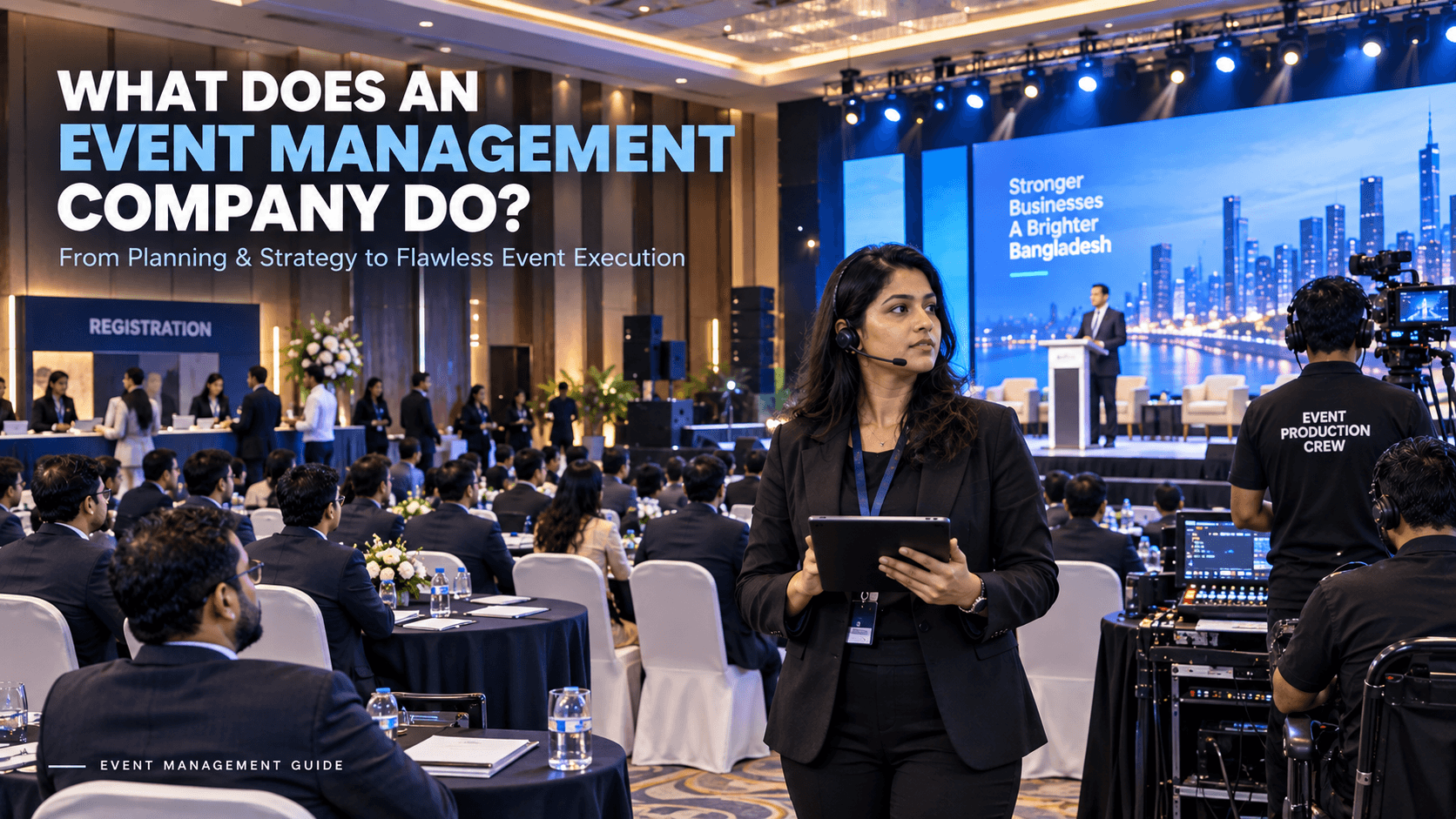
An event management company plans, organizes, and runs events end to end. It handles the initial strategy, builds the budget, books the venue, coordinates the vendors, oversees the technical production, manages the on-site execution, and delivers the post-event reporting. You hire one accountable team to own the entire project rather than chasing caterers, printers, and technicians yourself.
Consider the reality of a corporate product launch. A brand might have two internal marketing managers available to run it. That single event requires a secured location, staging, sound, lighting, printed materials, registration desks, crowd control, and a run sheet synced to the minute. An event management firm brings the operational blueprint, the established supplier network, and staff who have executed similar projects hundreds of times. The core job is simple: make the event happen on time and on budget so the client’s own team can focus on their business.
In this guide, you will find exactly what these companies deliver, where planning ends and management begins, the specific benefits of hiring an event planner, and how to choose a capable firm. NativeExpo International operates across Bangladesh and India, and our team’s field experience is used throughout this article to show how the event planning process works in practice.
What Is an Event Management Company?
An event management company is a specialized agency that takes full responsibility for producing an event on behalf of a client. This covers corporate, public, and private occasions. The work extends far beyond booking rooms and ordering chairs. A professional firm studies the business goal, sizes the target audience, allocates the budget, and coordinates every logistical moving part before the doors open.
The definition cited by the Wikipedia entry on event management frames it accurately. It describes the discipline as the application of project management to the creation and development of events. Event managers treat a launch or a conference as a strict project with a firm deadline, a fixed budget, and measurable outcomes. Once the event begins, the team manages the floor, solves technical issues out of sight, and ensures the schedule holds.
What Does an Event Management Company Actually Do? The Service Breakdown
If you deconstruct the workflow, the job splits into seven distinct phases. Most event management services deliver these as a single package, though some agencies handle them individually.
1. Strategy and Concept Development
The work begins weeks or months before a venue is booked. The company sits with the client to define the exact objective. A sales conference requires a completely different flow than a public market activation. The agency designs the theme, sets the agenda, and maps out the audience experience. From this, they build a master timeline detailing what must happen, who is responsible, and the final deadline for each task.
2. Event Budget Planning and Cost Control
Every professional proposal starts with a line-item budget. This document tracks the venue, staging, audio-visual equipment, printing, catering, government permits, staffing, and a strict contingency fund. A competent firm tracks daily spend against this plan and flags variances early. Because established companies book the same suppliers regularly, they secure volume rates that a one-off corporate buyer cannot access. This discount often covers a significant portion of the agency’s fee.
3. Venue Management and Logistics
The firm shortlists locations that fit the headcount, format, and budget. In a densely populated city, venue management in Dhaka requires checking variables like heavy vehicle access for load-in, backup generator capacity, and parking limits. The company negotiates the contract terms and designs the floor plan. They dictate where the main stage sits, how foot traffic flows, and where emergency exits remain clear.
4. Vendor and Supplier Coordination
Live events run on subcontractors. The event company selects the caterers, printers, lighting crews, decorators, and transport providers. They manage the contracts and synchronize the load-in schedules. Instead of a marketing manager juggling fifteen different supplier phone calls on the morning of a show, the client speaks to one dedicated project leader. This vetted vendor network is the primary asset you purchase when hiring an agency.
5. Event Production and Fabrication
Event production covers the physical build. It includes the staging, lighting rigs, sound systems, and LED screens. For trade shows, this extends to structural fabrication. Designing and building a custom exhibition booth is a highly specialized arm of the industry. A booth that fails to draw foot traffic fails its primary business purpose. NativeExpo International actively focuses on using eco-friendly materials and sustainable event design during this fabrication phase to reduce post-event waste. Production also covers technical contingencies: securing a secondary power source or preparing weather backups for outdoor activations.
6. On-Site Execution
This phase tests the preparation. On the day of the event, the crew arrives hours early. They supervise the final setup, manage guest registrations, keep speakers to their allotted time, and handle VIP logistics. When you hire an agency, technical failures get solved quietly behind the scenes by professionals who have seen the issue before. The client’s job on the day is to network with their guests, not to troubleshoot a broken microphone.
7. Post-Event Wrap-Up
Professional event coordinator duties do not end when the audience leaves. The company manages the physical teardown, settles final vendor invoices, and gathers attendee feedback. They deliver a post-event report detailing the final budget versus actual spend, attendance metrics, and operational notes. This data becomes the baseline for making the next event more efficient.
Event Planning vs Event Management: Understanding the Difference
The terms are often used interchangeably. However, the distinction is critical when reviewing agency contracts.
Event planning is the upfront organizational work. It involves setting the objectives, designing the theme, building the budget, and selecting the venue and vendors. Event management is the execution of that plan. It covers the entire lifecycle from the first concept meeting through the live, on-site supervision to the final reporting.
Think of it in construction terms. Planning is drawing the blueprint. Management is running the construction site. If a vendor quote specifies “planning only,” you will likely be responsible for running the actual event on the day. A “full management” contract means the agency owns the outcome from start to finish.
What Types of Events Do These Companies Run?
The industry handles a wide variety of formats, but a full-service corporate event management company typically focuses on the following categories:
- Conferences and Corporate Meetings: Annual general meetings, sales kickoffs, industry summits, and executive retreats.
- Trade Show and Expo Management: The agency manages the overall show floor, exhibitor logistics, crowd flow, and business exhibitions in Dhaka.
- Product Launch Events: High-production reveals designed for media coverage and tight scheduling.
- Brand Activation and Field Marketing: Retail promotions, sampling booths, and ATL and BTL marketing campaigns that place the brand directly in front of target demographics across multiple city locations.
- Social and Corporate Functions: Award nights, gala dinners, and corporate social responsibility days.
The Benefits of Hiring an Event Planner in Bangladesh
Executing an event in Dhaka presents highly specific logistical hurdles. Severe traffic cuts into tight setup windows. Premium venues book out months in advance. Fabrication deadlines frequently slip, and sudden weather changes disrupt outdoor plans. A local agency anticipates and solves these exact problems.
Time recovery is the primary benefit. An in-house team attempting to organize a large conference will spend hundreds of hours chasing vendor quotes and following up on printing delays. With an agency partner, the internal team simply reviews structural plans and provides final sign-off.
Risk mitigation is the second major factor. Capable teams carry backup equipment and know how to operate in difficult environments. In 2022, NativeExpo International ran a month-long event at Bhasan Char with Rohingya communities during the World Cup. Operating in that location required moving heavy supplies by water, securing reliable power in a remote setting, and coordinating daily with local authorities. When a team can successfully manage event logistics under those extreme constraints, executing a standard hotel ballroom conference becomes a highly controlled, predictable process.
How Much Does Event Management Cost in Bangladesh?
There is no standard flat rate for event management because the cost scales directly with the scope. The primary variables include the venue rental, the total guest count, the technical production level (a basic PA system versus a complex LED wall and concert lighting), and the need for custom fabrication.
A credible firm will always quote by detailed line item rather than offering a vague headline figure. [GAP: NativeExpo’s starting rate and typical budget range for a small or medium corporate event, to be supplied by the company.] The tighter your initial brief, the more accurate the quote will be. Agencies must price unknown variables into their risk margin. A clearly defined date, headcount, and objective will consistently result in a more efficient budget.
How to Choose an Event Management Company in Dhaka
Evaluate any potential agency shortlist using these five criteria:
- Look for matching experience. An agency that excels at outdoor brand activations might not be the right fit for a formal financial conference. Ask for case studies that match your specific format.
- Evaluate the personnel. The age of the company matters less than the experience of the actual staff. NativeExpo operates as a younger corporate entity, yet our core team members each bring over 8 years of direct industry experience. That practical knowledge dictates the success of the event.
- Demand operational detail. A professional firm will present a timeline and a preliminary budget breakdown before asking for a deposit. Avoid agencies that only provide glossy mood boards.
- Test their contingency planning. Ask the agency how they handle a power failure, a delayed keynote speaker, or a severe rain forecast. Their answer will reveal their actual operational competence.
- Verify local capability. Ensure the agency has direct experience dealing with local authorities and securing the necessary permits for your chosen venue.
Frequently Asked Questions
What does an event management company do?
An event management company plans, organizes, and runs events end to end. It handles strategy, budgeting, venue booking, vendor coordination, event production, on-site execution, and post-event reporting.
What is the difference between event planning vs event management?
Planning is the upfront work: defining objectives, setting budgets, and selecting vendors. Event management encompasses the entire lifecycle, from the initial strategy through live execution and final reporting. Planning is a subset of management.
What types of events do event management companies organize?
They handle corporate conferences, product launches, trade shows and expos, brand activations, and large-scale corporate functions. Full-service agencies manage the technical production and logistics for all these formats.
How much does it cost to hire an event management company in Dhaka?
Costs scale directly with the event scope. The venue, guest count, technical requirements, and custom fabrication dictate the price. Professional firms provide detailed line-item quotes based on your specific requirements.
Why should my company hire an event management firm instead of planning in-house?
Hiring a firm frees up hundreds of internal working hours, leverages established supplier networks to secure better rates, and provides professional contingency planning to prevent the technical and logistical failures that frequently disrupt in-house events.
Working with NativeExpo International
NativeExpo International is a full-service event management company in Dhaka, operating from 2/7 Block F, Lalmatia, Dhaka-1207. We combine 8+ years of individual team experience with dedicated in-house production capabilities. Our services span event production, custom stall design, expo management, and targeted market activations across Bangladesh and India, with current expansion into Nepal and Bhutan.
If you are currently outlining an upcoming corporate event and need to understand the logistical requirements, we provide straightforward operational advice. Reach our team at +880 1309-338077 or business@nativexpo.com, or submit your brief through our contact page. Provide your objective, tentative date, and estimated headcount. You will receive a practical execution plan, not a sales pitch.

No Comments